Afghanistan Money, Banknotes, and Banking System
Money plays a central role in Afghanistan’s social and economic life. It is used in markets, businesses, government payments, salaries, and daily household expenses. Throughout its history, Afghanistan has experienced many political and economic changes that strongly affected its currency and banking system. Despite wars, instability, and reforms, the country has maintained a national currency, formal banknotes, banks, and financial services such as ATMs and money transfer systems.
Name and Symbol of Afghan Currency
The official and only legal currency of Afghanistan is the Afghan Afghani. Its international currency code is AFN, and its symbol is ؋, also written as Af or Afs for plural use. In Pashto it is known as Afghani (افغانۍ) and in Dari as Afghani (افغانی). The afghani has officially held this status since the 1920s and is issued and managed solely by Da Afghanistan Bank, the country’s central bank.
Early History of Money in Afghanistan
In earlier times, Afghanistan relied on barter systems and foreign currencies for trade. From 1891, the Afghan rupee was commonly used. A major change occurred in 1923 during the reign of King Amanullah Khan, when the original afghani was introduced. The afghani replaced the Afghan rupee and was subdivided into 100 puls. It was based on silver and initially contained 9 grams of silver. This reform helped modernize Afghanistan’s monetary system and supported the adoption of a single metric system across the country.
Development of Afghan Banknotes
Between 1925 and 1928, the first treasury notes were issued in limited denominations. In 1939, Da Afghanistan Bank officially took control of banknote issuance. Over time, more denominations were added, and the design of banknotes changed to include national symbols, mosques, historical monuments, and important Afghan figures. During the civil war, many different groups printed their own banknotes, which caused serious inflation, loss of trust, and lack of standardization in the currency.
Modern Afghan Banknotes
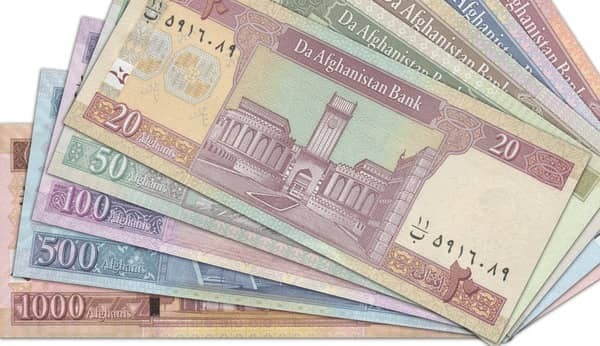
Afghanistan currently has nine types of banknotes: 1, 2, 5, 10, 20, 50, 100, 500, and 1,000 afghanis. Each banknote has a distinct size, color, and design that represents Afghanistan’s history and cultural heritage.
- The 1 Afghani (pink), 2 Afghani (blue), and 5 Afghani (brown) banknotes all display the seal of Da Afghanistan Bank on the front, featuring a Eucratides I-era coin. On the reverse side, the 1 Afghani shows the Blue Mosque of Mazar-i-Sharif, the 2 Afghani shows Taq-e-Zafar in Kabul, and the 5 Afghani shows the Bala Hissar Fortress in Kabul. The Af. 1, Afs. 2 and Afs. 5 notes were replaced by coins in 2005.
- The 10 Afghani banknote is yellow-green and shows the Ahmad Shah Durrani Mausoleum in Kandahar on the front, with Taq-e-Zafar and Lion Gate on the reverse.
- The 20 Afghani note is brown and displays the Tomb of Mahmud of Ghazni on the front and the Arg King’s Palace in Kabul on the back.
- The 50 Afghani note is dark green and shows the Shah-Do Shamshira Mosque in Kabul and the Salang Pass.
- The 100 Afghani note is violet, showing the Pul-e-Khishti Mosque and the Bost Fortress in Helmand.
- The 500 Afghani note is blue and displays the Great Mosque of Herat and the Kandahar International Airport tower.
- The 1,000 Afghani note is orange and shows the Blue Mosque of Mazar-i-Sharif and the Tomb of Ahmad Shah Durrani in Kandahar.
Security features were improved in 2004 and 2008, and a redesigned 1,000 afghani banknote was introduced in 2014 to reduce counterfeiting.
Central Banking in Afghanistan
Da Afghanistan Bank (DAB) is the central bank of Afghanistan and was established in 1939. It is fully government-owned and responsible for issuing currency, regulating banks, and managing monetary policy. DAB operates about 52 branches across the country, including seven in Kabul. It also supervises exchange rate policies and works to maintain financial stability and public confidence.
Banking System in Afghanistan
The Afghan banking system consists of three main categories of banks. The central bank is Da Afghanistan Bank. The state-owned banks include Bank-e-Millie Afghan, Pashtany Bank, and New Kabul Bank. The private local banks include Afghanistan International Bank, Azizi Bank, Islamic Bank of Afghanistan, Maiwand Bank, Ghazanfar Bank, and Afghan United Bank. These banks provide basic financial services such as deposits, withdrawals, transfers, salary payments, and tax payments.
ATMs in Afghanistan
ATM services operate in Afghanistan, mainly in large cities. Banks that provide ATM machines include Afghanistan International Bank, Azizi Bank, New Kabul Bank, Ghazanfar Bank, Bank-e-Millie Afghan, and the Islamic Bank of Afghanistan. These ATMs allow customers to withdraw cash using bank cards and provide limited electronic access to bank funds.
Availability and Challenges of ATMs
ATMs are mostly available in major urban centers such as Kabul, Herat, Kandahar, Mazar-i-Sharif, Jalalabad, and Bamyan. Rural areas generally lack access to ATM facilities.
Digital Banking and Cash Usage
Although some mobile money and electronic payment services exist, Afghanistan remains a strongly cash-based economy. A large portion of money circulates outside the formal banking system. Cash is preferred for everyday transactions due to limited digital infrastructure, restricted banking access, and public caution toward electronic services.
Current Situation and Public Trust
Public trust in the banking system has been weakened by decades of conflict, currency instability, and recent financial restrictions. Many people prefer to keep their savings in cash rather than in banks. The banking sector remains fragile, with limited lending, liquidity pressures, and regulatory uncertainty. While inflation is low and the afghani has shown periods of strength, financial inclusion remains limited.
Conclusion
The history of Afghan money and banking reflects the broader history of Afghanistan itself. From early silver-based currency to modern banknotes featuring national landmarks, the afghani remains a strong symbol of national identity. Banks, ATMs, and money transfer services such as Western Union, supported by New Kabul Bank and Azizi Bank, continue to operate despite challenges. Strengthening stability, public trust, and financial access will be essential for the future development of Afghanistan’s banking system.
References
- https://en.wikipedia.org/wiki/Afghan_afghani
- https://en.wikipedia.org/wiki/Da_Afghanistan_Bank
- https://en.wikipedia.org/wiki/List_of_banks_in_Afghanistan
Let’s Go Afghanistan Team
FAQ
- is it easy to use ATMs in Afghanistan?
- Is Afghanistan a cash-based economy?